The social media giant Meta recently announced plans to stop providing end-to-end encryption support for chats on Instagram from 8 May 2026.
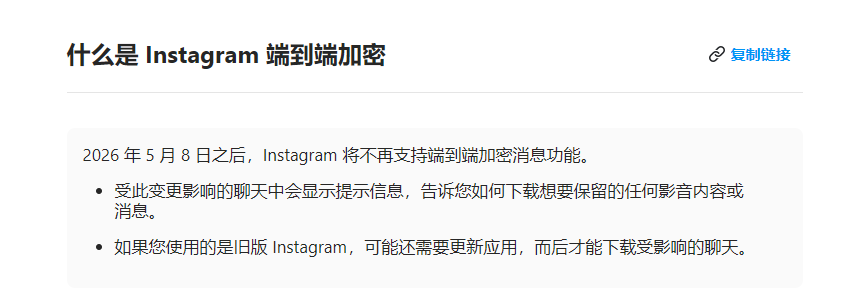
Meta states: “The chats affected by this change will show a hint of how to download any audio content or message you want to keep. If you use an old version of Instagram, you may need to update the application before downloading the affected chat.
In response to media queries, Meta responded: “It is very rare that people choose to use end-to-end encryption messages in private letters, so we will remove this option from Instagram in the coming months. Anyone who wishes to continue using end-to-end encrypted communications can easily do so on the WhatsApp.” Meta began testing the end-to-end encryption of Instagram’s direct message for the first time in 2021, as part of CEO Mark Zuckerberg’s “Presentation of a Privacy Focused Social Network”. This feature is currently “only available in certain areas” and is not default-enabled. In February 2022, Instagram opened the encryption of direct messages to all adult users in both Russia and Ukraine. It’s worth noting that the Instagram End was declared closed at Meta. A few days before the end-to-end encryption, TikTok had just indicated that it did not plan to introduce end-to-end encryption to protect the direct message on the platform, explaining to BBC News that the technology would make users more insecure and that the platform wanted to protect users, especially young people, from harm.

Late last month, Reuters reported that, despite internal warnings in 2019 that this would impede the ability of companies to detect and report illegal activities such as child sexual abuse materials or terrorist propaganda to law enforcement, Meta had advanced plans to use encryption to protect news on Facebook and Instagram. End-to-end encryption is hailed as a victory for privacy protection, as it ensures that only communication parties can decrypt and read information, thus excluding service providers, malicious actors and other third parties from data access or interception. However, law enforcement and child advocates believe that the technology creates a safe space for criminals, as it prevents companies from complying with search warrants to provide information.

This year, the European Commission is expected to launch a “technical road map” on encryption technology aimed at identifying and assessing solutions that would allow law enforcement to have legal access to encrypted data, while safeguarding cybersecurity and fundamental rights.

Related Posts