The British Government announced that it had signed an agreement with the artificial intelligence company OpenAI to use its AI technology to improve the effectiveness of the British public service. This cooperation agreement between OpenAI and the British Ministry of Innovation and Technology may allow the company access to government data and apply its software to the education, defence, security and justice systems.
The British Minister of Technology, Peter Kyle, declared that artificial intelligence would be the “core driver of change in Britain” and the “engine of economic growth”. However, DHR has criticized this collaboration as revealing “the current government’s belief in the increasingly suspicious commercial propaganda of science and technology giants”.
The agreement indicates that the parties will establish an “information-sharing mechanism” to “develop safeguards to protect the public and uphold democratic values”, while exploring investments in artificial intelligence infrastructure, usually involving the construction or expansion of large data centres to support AI operations. OpenAI also plans to expand its London office (with over 100 current staff).
This commitment is a statement of intent, not a binding legal agreement, and is intended to clarify the aims of cooperation between the British Government and OpenAI. CEO OpenAI Sam Altman declared that the plan would “create prosperity for all”. Dr. Gordon Fletcher, Vice-President of Scientific Innovation, University of Solford, believes that cooperation is expected to unleash the energy of a highly qualified civil servant to focus on “one million-thousand-a-million probability complex events”, but the key is “to achieve a truly transparent and ethical operation with minimal public data”.
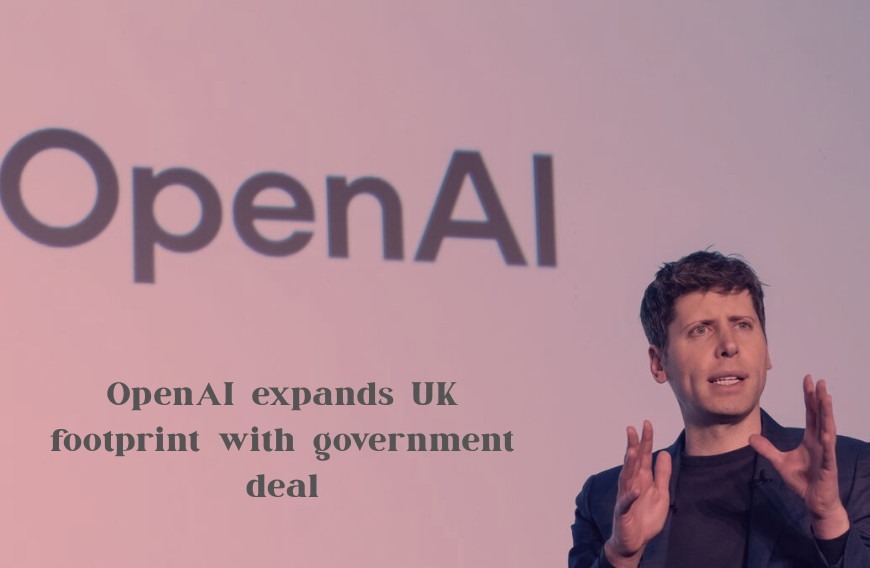
The digital rights organization Foxglove directly refers to the agreement as “unpredictable.” Co-Director Martha Dach warned that the public data available to the government “the treasure bank is of great commercial value to the next generation of ChatGPT trained by OpenAI” and that “the Secretary of State’s insistence on inducing wolves in matters concerning British sovereignty is incomprehensible.”
Government transparency data indicate that Peter Kyle had dinner with Altman in March and April this year. He recently revealed to McRocklin, former consultant on Downing Street, that he had to deal with “global enterprises with far greater capacity for innovation than the British Government”. This is at a time when the United Kingdom is seeking to boost economic stagnation (a growth rate of 0.1 to 0.2 per cent is projected for April-June). British Prime Minister Stammer announced in January that the Artificial Intelligence Opportunity Action Plan, supported by a number of technology giants, was designed to stimulate growth, but Tim Fragg, Chief Operator of the British AI Industry Agency, criticized the plan for its “simplistic” perception of industry contributors, focusing too much on technology giants.
The British Government has shown openness to US-AI investments, and a similar agreement was reached earlier this year with OpenAI’s competitors Google and Anthropic. Officially, this cooperation “can lead to the development of AI technologies in the UK, driving the major discoveries of growth”. The Government has now used the OpenAI model in the Civil Service Efficiency AI tool called “Hamley”.
The Labour Party government’s warm embrace of AI has been repeatedly questioned, for example by musicians protesting against its unauthorized use of music. The production-type AI of the ChatGPT class can generate text, images, videos and music in accordance with the directive, and its technical principles give rise to disputes over access to data and copyright infringement. The technology is also plagued by the generation of false information and false advice.

Related Posts